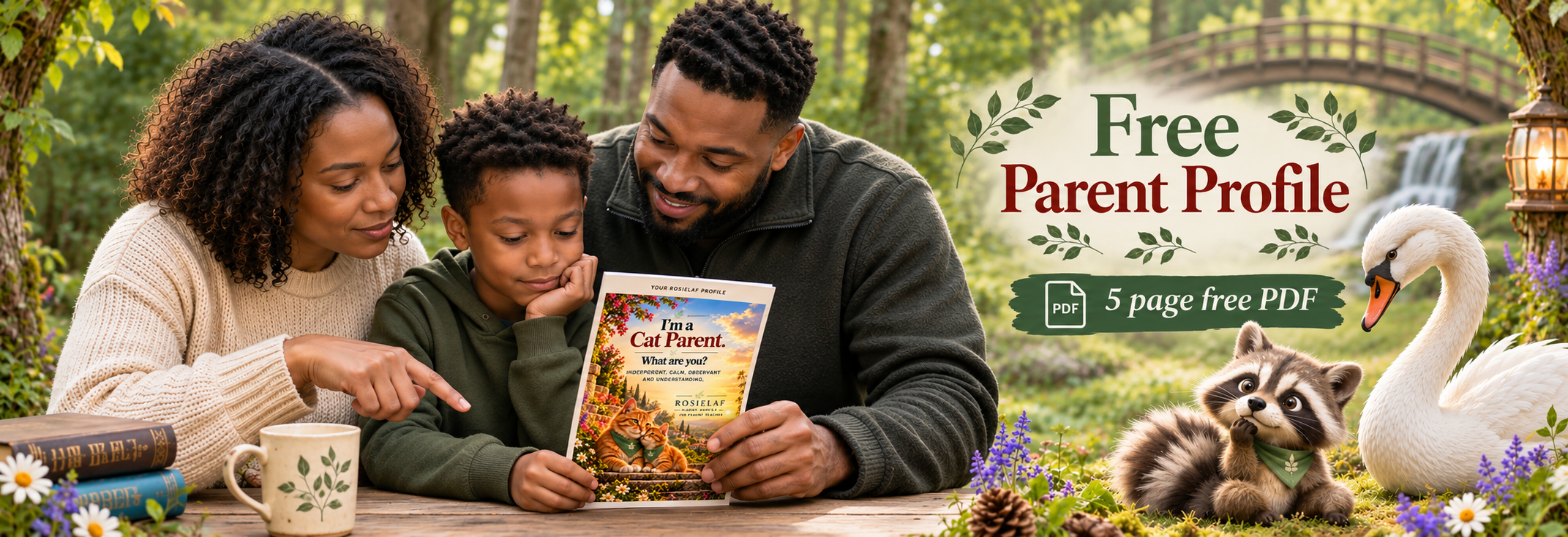
The free ROSIELAF Parent Profile
Same parent. Same rules.Two completely different children.
One does their reading without being asked. The other turns ten spellings into an hour of tears.
You give them both the same love, the same help, the same patience. So why does it work with one and blow up with the other?
Stop guessing what your child needs. First, understand yourself.
Discover your parenting animal and get your FREE 5-page Parent Profile to keep.
Completely free · No card details

A Lion? An Otter? A Meerkat?
Or something you never expected?
What you'll get, free
Your animal. Your strengths. And something to try this week.
01 · Recognise
What you already bring
The strengths you can lean on, even on the days nobody is listening.

02 · Understand
When you're stretched
A kind, honest look at what you tend to do under pressure. The bit most of us never see in ourselves.
03 · Try
Something for this week
Practical phrases and one small change to try with your children.

04 · Connect
Who you click with
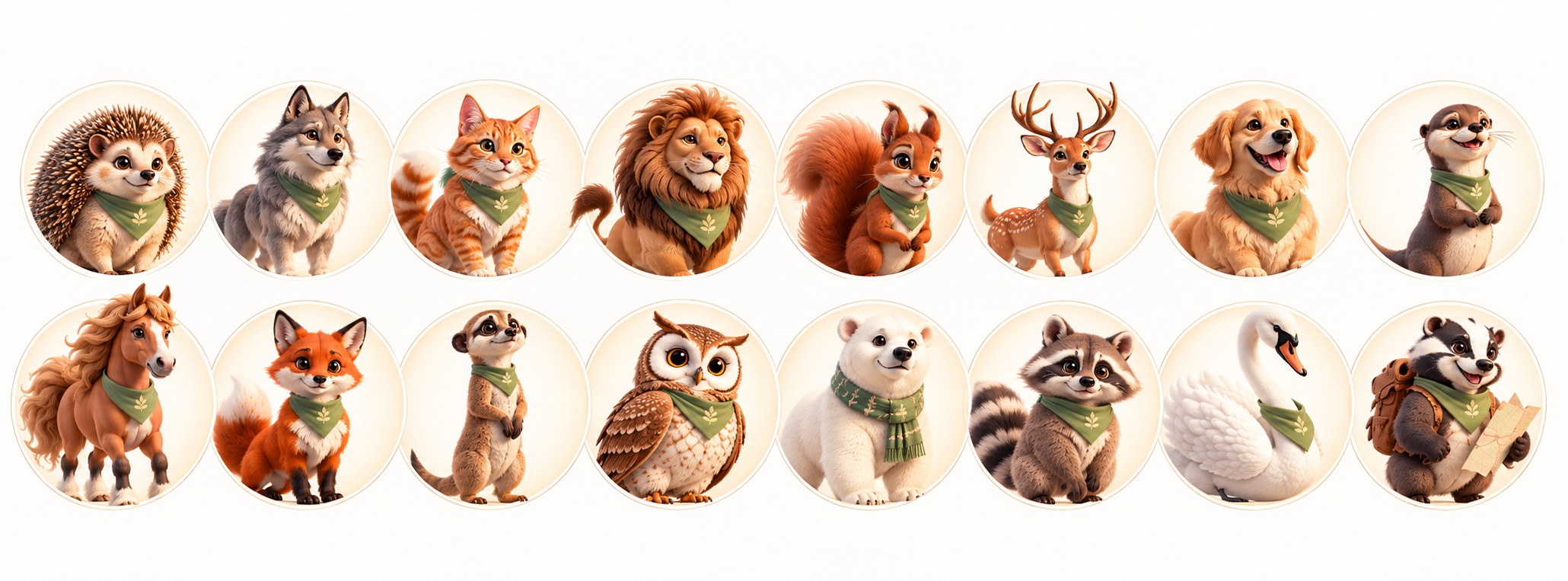
See which of the 16 child animals you're most likely to click with, and which may test you most.
Your profile opens on the page straight away, then download your 5-page PDF to keep.
16 parenting animals. Which one explains the way you think, teach and connect with your child?
Does this sound like your house?
It's the everyday moments that leave you wondering.

"How was your day?"
One tells you every detail before her coat is off. The other says "fine" and disappears upstairs.

"I'm only trying to help!"
You sit down to explain one maths question. Ten minutes later, someone is in tears. Sometimes it's you.
"That's not fair!"
One needs a cuddle and five more minutes of talking. The other wants the light off and to be left alone.
Your children aren't trying to wind you up. They simply need different things from the same parent.And the way you naturally parent suits one of them more than the other.
A moment you might recognise
"I don't want you to fix it, Mum!"
Abby came home from school, threw her rucksack onto a chair, then slumped onto the sofa, bursting into tears.
"They were all talking behind my back and leaving me out today."
Suddenly, Mum knew exactly what to do.
"Well, I'll ring their mothers and have words with them."
"No! That'll make it worse!"
Abby stormed upstairs. "I KNEW you wouldn't understand!"
But her daughter hadn't come home looking for a solution. She'd come home wanting someone to understand how awful her day had been.
Abby was a Meerkat. Her mother was a Polar Bear. Neither was trying to upset the other. They simply needed different things from the same conversation.
"Do you want me to help you solve it, or do you just need me to listen?"
Which one are you - the problem-solver or the listener?

Why I created ROSIELAF
I saw this in my own classroom.
In 2023, I took over the most challenging Year 6 class of my 30-year teaching career. They nearly brought me to my knees.
Yet the class next door treated me like a celebrity. They cheered every time I walked in.
One class treated me like “meh.” The other acted like Taylor Swift had walked in.
Same teacher. Same school.
Two completely different reactions.
Keep reading my story
The engineer in me had to understand why.
But personality tests like MBTI, the Enneagram and OCEAN were made for adults, not children. So I used my psychology background to create my own. I profiled every child in my classes. I even asked some of the staff to take my assessment.
The results blew me away.
By the end of the year, my challenging class loved me too, because I was finally giving them what they needed.
Three years of refining my assessment later, ROSIELAF was born, so parents could see those differences in their own families.
I now use ROSIELAF at the start of my GATE programme, before we begin working with a parent and their child. Exploring parent and child compatibility gives us all valuable insight into where they naturally connect, where they might misunderstand each other, and how we can make learning together easier.
And I see those differences in my own family too.
I’m a mother of three. Same parents. Same household. Three completely different children.
My youngest and I share the same animal profile. We’re 90% compatible. She’s so easy to parent, we even finish each other’s sentences.
But here’s what makes ROSIELAF different from other psychological assessments. My daughter and I are both Swans, yet we are not the same Swan. Our reports are different. Nobody fits into 16 neat boxes, and that’s just as it should be.
So find out how you and your child see the world, and how you can understand each other better.
I’m a Swan parent. What are you?
Sabina Bashir · Founder, The Parent Teacher
Understand the relationship. Watch them thrive.

Founder, The Parent Teacher
MSc Psych, BEng (Hons), PGCE, Adv Dip Child Dev, Dip SEND, Dip Neuroplasticity
Before you start
The things you're probably wondering.
Is it really free?
Yes. Your Parent Profile is free, and there are no card details to enter. If you'd like to see your children's animals and how you fit together later, that's a separate Family Profile. You never have to buy it to get your own result.
Is this going to tell me I'm a bad parent?
No. There are no right or wrong answers. Every animal has strengths, and every animal has a side that shows up when it's tired and stretched. Yours included. Mine included.
Can my partner take it too?
Yes. Mums, dads and grandparents can each take their own free profile. Many couples find they are completely different animals, which explains a lot.
Do my children need to answer anything?
No. This first profile is just for you. Their animals come later, if you want them.
Will I be signed up to lots of emails?
No. You enter your name and email so your profile can be created and sent to you. Extra tips from me are optional, and you can unsubscribe at any time.
What happens to my answers?
Your profile is created right here on the page, and no child data is stored. See how I keep your family's information private.
Why an animal?
Because "I'm a Polar Bear and she's a Meerkat" is far easier to remember in the middle of a row than a psychology label. Behind every animal is the assessment I built and refined over three years. It's a reflection tool, not a diagnosis, and your animal is a starting point, not a fixed definition of you.
What R.O.S.I.E.L.A.F. stands for
R.O.S.I.E.L.A.F. isn't a made-up word. Every letter means something.
Every parent and every child leans one way or the other on four things. Psychologists call them preferences. You'll recognise them at your kitchen table.
Reserved or Outgoing
Do you recharge quietly, or by talking it out?
One child tells you every detail of their day. The other says "fine" and goes upstairs.
Sensory or Instinctive
Do you follow the steps one at a time, or go with what feels right?
You want them to read the instructions first. They've already started.
Empathetic or Logical
When something goes wrong, do you think about how everyone feels first, or what makes sense?
You want to fix the problem. They want you to understand how awful it felt.
Anchored or Flexible
Do you like a plan, or would you rather go with the flow?
You said homework at four. They thought "later" meant later.
Your animal is where your four answers meet.
Your child has four of their own.
When they don't match, homework is where you feel it.
But nobody fits neatly into 16 boxes.
Two Swans can still be very different Swans. Your animal is the beginning, not the whole picture.
That's why the Family Profile looks deeper. It looks at five everyday tendencies: how you feel about trying new things, how you follow things through, where your social energy comes from, how you handle differences, and how you handle pressure.
Then it looks underneath all of that, at what matters most to each of you. For one person, it's feeling secure. For another, it's freedom, or doing what's right, or keeping the peace.
So two parents with the same animal can get two very different reports. Just as they should.
The Christmas holidays are coming.
No routine, late nights, too much sugar, and everyone under one roof.
Start with the one person in the house you can understand tonight. You.
Completely free · No card details